
by Anita Hartley
The Railroad
“Now we will grow, and fast.”
“Better get used to hearing the whistles.”
“This is real progress.”
The Mississippi and Missouri railroads were coming. Construction on the railroad began in 1855. Even though a railroad bridge across the Mississippi River had not been built yet, engines were ferried over the river to pull the work trains. By Oct. 1 of that year, those trains reached Wilton. And construction of the rails continues on, until it was halted by the Civil War. Soon after the war, that railroad passed into the hands of the Chicago, Rock Island and Pacific Lines.
The railroad was now big business in Wilton. There were probably 100 to 125 railroad men living there, some with families, others living in hotels and rooming houses.
A roundhouse and turntable and carpenter and blacksmith shops were there. Telegraph operators, engineers, brakemen, conductors and others lived here.
One reason for the great success was the immense amount of grain heading for market. As many as 42 trains arrived and departed in a day’s time. The important hub of Wilton was known as the “junction in Wilton.” Or maybe “Wilton Junction,” which became the nickname of the town for many years, though it was officially platted as “Wilton.”
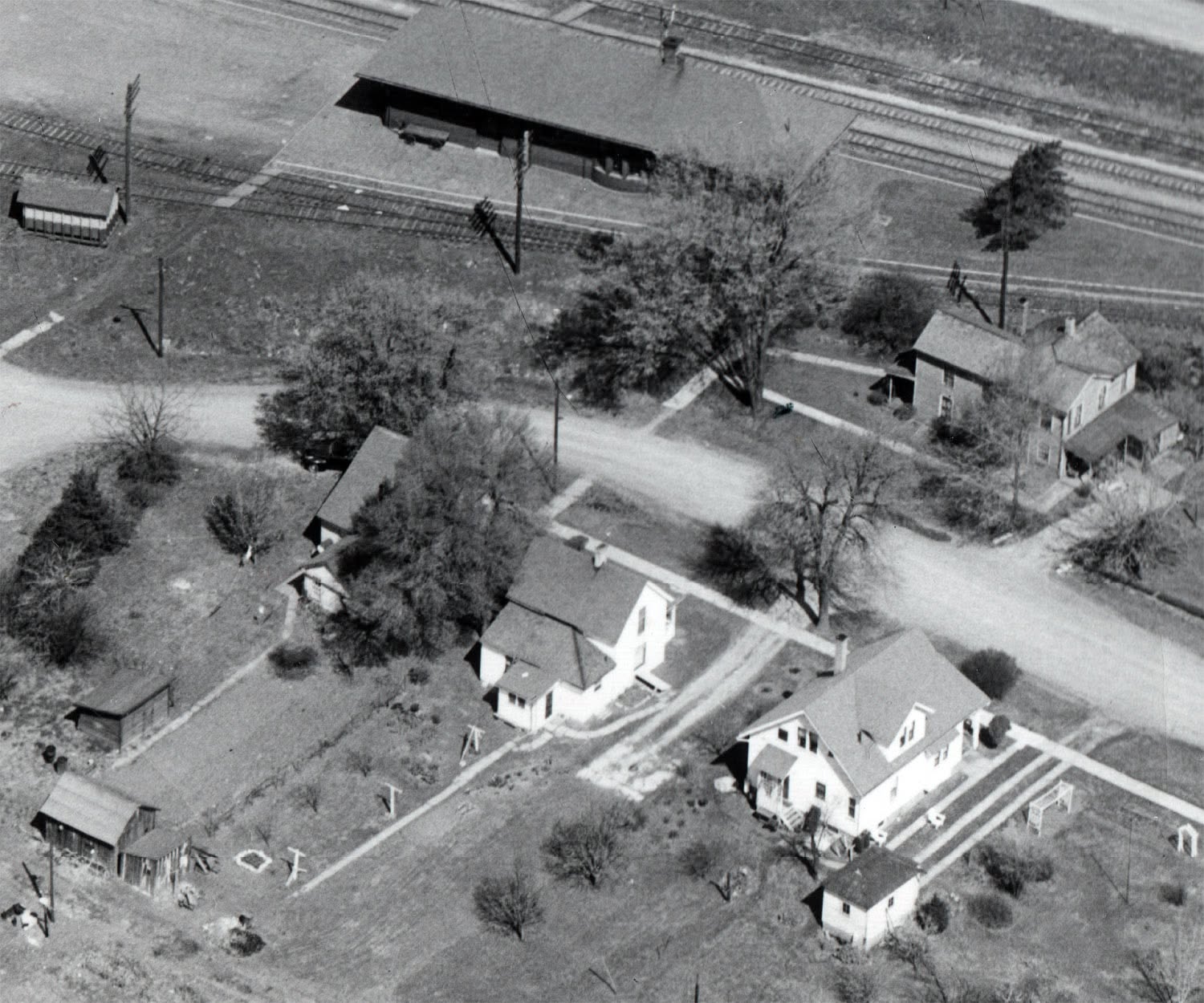
A brick depot was built in 1898. On the 70th anniversary, a memorial pine tree was planted on the east side of the building. After the railroad’s decline, the building became in a state of ruin. It was restored and is now a museum, open to the public during open hours, and managed by the Wilton Historical Society. It is on the U.S. Register of Historic Places.
Milk and cream, livestock, and grain went to Chicago, as did passengers. “All aboard at the junction in Wilton!” Trains still stopped to take on water, provided by Mud Creek. Mail was also brought to Wilton by train.
In 1881 a line of track was laid from Muscatine to Davenport. Trains were routed that way instead of through Wilton. The roundhouse and other shops were moved farther west. And when long-distance trucking became common, the importance of the railroad declined.
The Plug was a short track that travelled from Wilton to Muscatine, making four trips a day by 1900. In the spring of 1958, by special arrangement, the Senior class of Wilton High School was picked up at the depot one evening for a ride to Chicago for a Class Trip day. They returned the next evening, with the privilege of being the only passengers served by the depot in many years.
Sources: Wilton, Mosco, and Yesteryear (1976) and Henry Wildasin’s History of Wilton Iowa (1947).
The Depot in 1953 from Ted Marolf's facebook page:
The Pond at City Park
“I used to play there a lot.”
“Me too.”
“Once I had my birthday party there.”
Me too.”
The pond in the park was pretty and popular. Younger residents will say, “What pond? Which park?” Once upon a time in Wilton (Jct.) there was only one park, City Park. And there was a big pond in that park.
It stretched past the west door of the stone shelter, starting at the south edge of the park, and went about two-thirds of the way to the north, almost dividing the park in half.
Several benches were placed along the edges, and a picnic table was nearby. Light poles made nighttime safe and were especially helpful for ice skating after dark.
Many miles were skated on that pond. Rowdy hockey games were played. Some thought it was funny to pull the benches no the ice and push them around.
School classes held nighttime skating parties there, and a metal drum could be used as a fire pit for warmth. Even kids without skates would attend these for fun. Of course, where there is a bonfire, wieners and marshmallows were roasted and toasted.
No wading or swimming was allowed. That doesn’t mean it didn’t happen. Some summers the pond was stocked with pan fish and a fishing derby for kids was held. Fun to do and fun to watch. Playground equipment was well used. One couple claimed they got engaged at the pond.
But there were those who thought the pond was perilous. An organized campaign was formed and people went door-to-door asking adults to sign a petition to remove the pond. Whether this was successful, or there were other reasons known to the Council, sometimes in the mid-1960’s the pond was filled in.
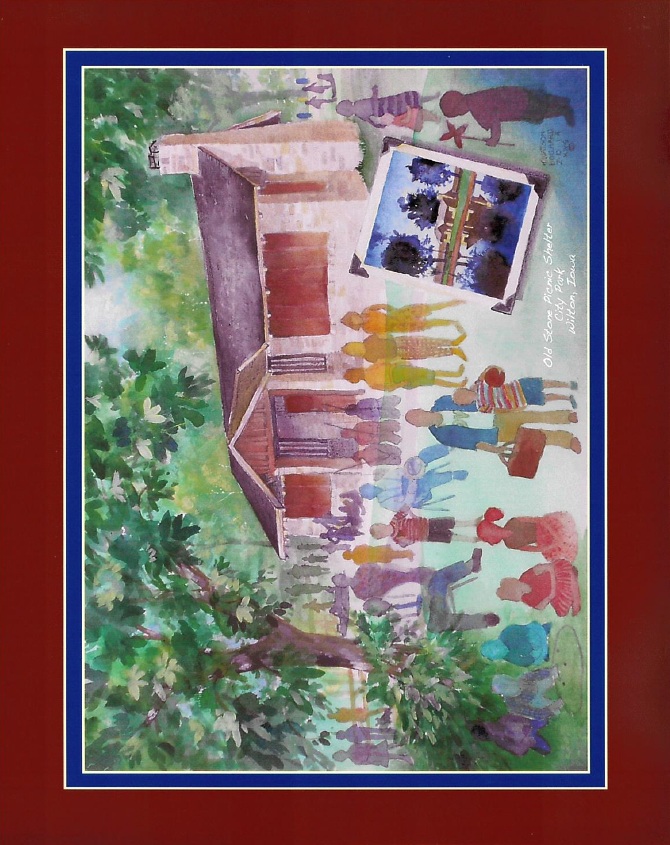
In the Wilton Public Library, there is a painting by former rural Wilton resident Twyla Whitmer of the shelter and scenery at the park. She received a photo of the pond and added it as an insert in the painting.
On the local history shelves at the library is a blue folder with photos taken at the park near the pond as well as some aerial views of the park and pond. Interesting to look at, and you might be in one of those photos.
Pretty, popular, picture-perfect or perilous, the pond was part of the history of Wilton (Jct.)
Sources: the folder at the library and personal memories.
"Old Stone Picnic Shelter" by T. Watson Bogaard (Twyla Whitmer):
Wilton Public Library
“I am so glad we have this place.”
“Me too. I go there often.”
“And there is so much more there than books….”
In 1935, the Wilton Library opened for business, with 1000 books on the shelves. The town council offered free shared use of the council room and two small rooms with heat, lights, and furniture. Mrs. Etta Kelley was the new librarian, paid $10 a month.
The only access to books before the opening was a reading room sponsored by the Young Men’s Christian Union. At the start, it was for men only, but later, ladies were invited to attend on Fridays.
But interest was growing for a larger public library presence in the town of Wilton. In 1934, the Ladies Aid Society of the former Farmington Church offered their treasury, $407.23, to the NNC Club. The purpose of the gift was to promote a library. Many clubs and individuals were made aware of the project and an association was formed.
It succeeded because it was supported by the public. Monetary donations from private contributors and memorial gifts were used. Then, talent became the means of support. From 1936 through 1942, one-act plays were performed by local people. Citizens paid the fee to attend, and a silver travelling trophy was awarded to the best play each year. The winner’s title was engraved on that, and it now is on the local history shelves at the Library.
When the new City Hall was planned in 1938, a room especially for the library was included. The library moved around the building several times, each time for benefits of space and condition.
In 1963, the fire department built a larger addition on the west end of the building. The library moved into the vacated fire station. A money drive was conducted, and again, the public gave their dollars and support. And when the half on the east side of the building was no longer used for dances and other public events, it was turned into a new larger library.
A much larger space made it possible to begin programs and activities. The school art show items were hung there and could be seen on Smorgasbord night. Another popular event was a craft show with items by citizens on display and people available to teach tatting, crocheting, and other talents. Does anyone else remember taking part in READO, the summer kids’ reading program?
In 1944, the library was turned over to the City, became the Wilton Public Library, and was tax-supported. In the late 1980’s, the State Library of Iowa offered a program for librarians to become state-certified and libraries to be state-accredited. Our Wilton Public Library and librarians qualified the first year and continue to uphold the standards needed.
Now there is a large, attractive and well-used library attached to the south end of the Community Center at 1215 Cypress St. You can leave your wallet at home; no fees are levied for library cards, books, magazines, or movies. Programs are usually “no charge.” But donations are always welcome. Everyone is invited to join the Friends of Wilton Public Library group.
When you look at a library book, turn to page 35. Every book in the library is stamped with the “Wilton Public Library” identification stamp on that page. It’s a way to commemorate the first opening of an asset to our town.
Source: Wilton, Moscow & Yesteryear (1976).
The Fire Department
“Are you going to join?”
“Not sure if I have the skills.”
“I’m sure there will be help to learn them.”
From an article in the Wilton Review Dec. 14, 1876: “some of our young men have taken up the matter of organizing a fire company, and last Tuesday evening met and made up the following organization of officers, with a number of others joining.”
The City Council appointed a committee to investigate buying an engine for use by the City. The mayor was authorized to purchase a Little Giant Fire Engine for the sum of $425. A penalty of $10 was decided on for anyone driving over a fire hose, in any type of vehicle.
So the town of Wilton had its first fire engine and a group was formed to take up the job of fighting fires. The earlier department became two groups, Rescue Hook and Ladder #1 and Reliance Hose Company #2.
Both groups were competitive, and strived to be the first at the scene of a fire. They performed in tournaments and a trophy belt was awarded to Reliance Hook and Ladder for outstanding performance at three of them.
In March 1919, the two groups joined and became Wilton Volunteer Fire Department. In the early 1900’s, minutes state: “Moved and seconded that we go to the show at the expense of the Company. Carried. Meeting adjourned.” In 1915, minutes state: “Moved and seconded that we discontinue going to the show at expense of the Company.”
There is so much history to tell about the Wilton Fire Department, it can’t all be included in this essay. One thing is clear by listing of roll calls through the years, that nearly all of Wilton’s prominent citizens: lawyers, doctors, bankers, etc., were proud to be department members.
January 1975 articles of incorporation of the Wilton Volunteer Fire Department were drawn up and signed. Firemen take classes and attend fire training schools, some carry First Aid cards, and in the present day they assist with the Wilton Ambulance.
Fire trucks and equipment were housed for many years in the City Hall and now have a modern, large, and up-to-date Fire House on Fifth Street. They serve up a fantastic pancake feed once a year as a fundraiser.
Now think of this: Wilton Fire Department has been on-call and ready to assist the town and rural areas with constant service for 24 hours a day, seven days a week, 52 weeks a year, since 1876. Is there another organization that can beat this record?
Source: Wilton, Moscow & Yesteryear (1976).
Camp Fire Girls
“Did you belong to a group?”
“Yes, we had a good time earning honors”
“I remember when we went to camp.”
Camp Fire Girls was alive and well in Wilton for a very long time. It was named a national agency in Washington, D.C. in 1912. The watchword was “WoHeLo,” or Work, Health, Love.
During WWI the girls sold Liberty Bonds and helped support French and Belgian orphans. Names and honors were influenced by Native American culture and symbolism. Beads of achievement could be earned individually or as a club project.
Two Camp Firegroups were formed in Wilton in 1933, by Mrs. Curtis Frymoyer and Mrs. Elmer Swanson. Later, Mrs. Inez Harding was a leader who made a lasting impression on many girls. The groups were named Cheskchamey” and “Tallahassee.”
A camp was held each summer, in a large cottage on Crystal Lake near DeWitt. Girls rode to camp and home in the open back of a truck. Leaders and the older girls planned the activities and watched over the campers. Campers took food for the week from a planned list, and their own bedding. Visitors’ day was held near the end of the week, with the campers providing entertainment. Sometimes a girl found she was terribly homesick and left camp to return home with her mother. This camp was just for Wilton girls. In later years, a camp for all groups to use was established near Dixon, Iowa.
Camp Fire Girls sold chocolate candies in the fall as a fundraiser. They marched in the Memorial Day parade, carrying a large banner. A Father/Daughter event was planned, with a meal and a program. If a uniform was needed, it was a navy blue skirt, white blouse and red neck scarf.
In 1970, a tour project was planned, called Flight ’72. If girls could earn and save $1000 by June of 1972, they could travel to Europe. Five Wilton girls reached that goal and with their leaders, Mrs. Barton LaCrosse and Mrs. David Wiley, they went on that trip. They were Susan LaCrosse, Susan Stoelk, Kathy Stoelk, Susan Budding, and Pam Shotwell.
Though Camp Fire Girls no longer exists in Wilton, many memories of those days still linger. Some went on to lead a group, which might include their daughter finding her own experience in the WoHeLo way.
Sources: Henry Wildasin History of Wilton, Iowa (1947) and Wilton, Moscow, & Yesteryear (1976).
“If You Grew Up in Wilton, IA”
At the present time, there is a Facebook page entitled, “If You Grew Up in Wilton, IA.” Wilton has a rich history of interesting people and events. Here is a list of things that happened “way back when.” How many do you remember?
The Rocket train went roaring through town. The fire whistle blew each night at 6 p.m. Kids came out at night to play “Chalk the corner.” People knew where Renfro’s corner and Hatfield’s corner were. Pine Street hill was blocked off for snow sledding. People ice skated on the pond in City Park. The entire grade school went to the local movie theater near Christmas for a free show. And Santa was there at the end of the movie and handed out candy bags.
Watching at night for the red blinking light on top of the REA tower.
If you got an A on your report card and took it to the Candy Kitchen, you got a free one-dip ice cream cone. School dismissed early on REA day and students helped serve up beans at the meal. Almost impossible was crossing Highway 6 (5th Street) when a steady stream of cars headed west those Saturdays the Hawkeyes played home football games. Parking on the levee was a social event.
During Fire Prevention Week, firemen brought the trucks to the school and gave children rides. When called about an ill person, the doctor made a house call to take care of them. Jake the grocer called women customers “Honey” and asked, “Get a new Toni?” No one minded. Summer Saturday nights meant City Band concerts downtown. Moms told kids that night, “Meet me at 9 p.m. under the axe” and kids knew just where to go
Today’s events are tomorrow’s history. What is done in the present can affect the future.
Source: Wilton, Moscow & Yesteryear (1976).